PWC Lift Maintenance: Routine Care and Repair Costs
A practical guide to maintaining personal watercraft lifts, including inspection schedules, common wear items, and estimated service costs.
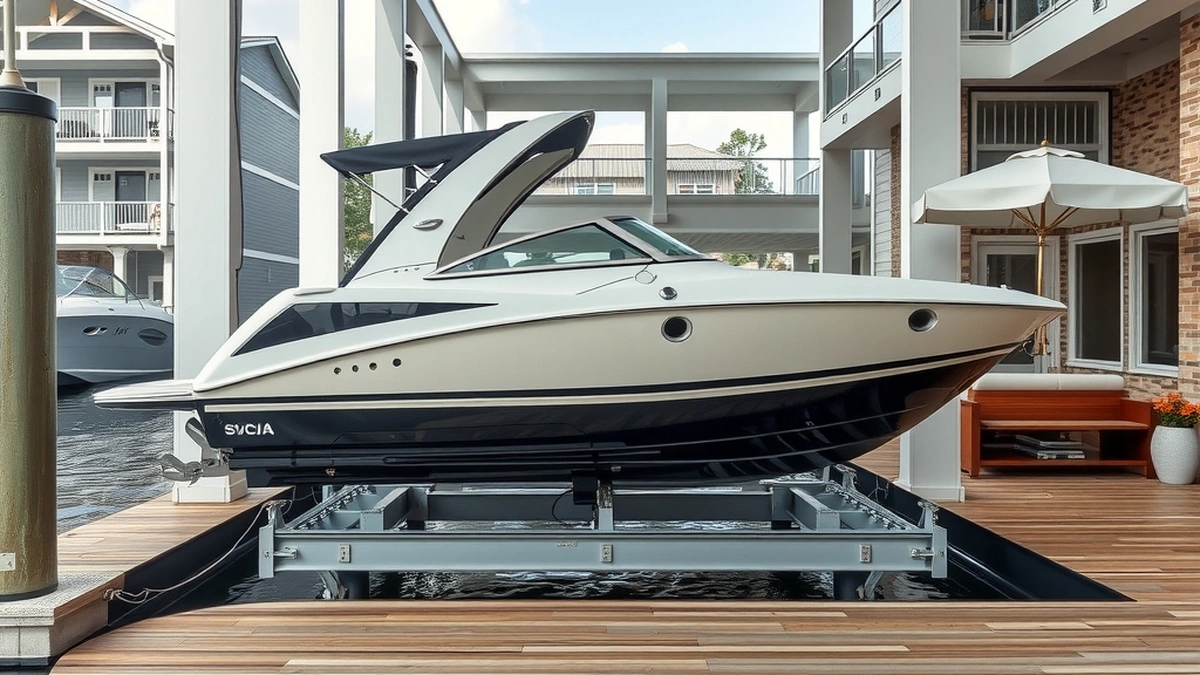
Inspect a PWC lift every 90 days, wash off salt and debris after each season, and replace worn cables or bunks before they fail to protect a craft worth thousands of dollars.
- Typical PWC lift price
- $1,500-$5,000
- Typical installation cost
- $1,000-$3,000
- Recommended inspection interval
- Every 90 days
- Common cable replacement cost
- $100-$300 per pair
Some links on this page are affiliate links.If you buy through them we may earn a commission at no extra cost to you. We do not accept payment for rankings. Read the full disclosure.
PWC lift maintenance is the routine inspection and repair work that keeps a personal watercraft lift safe between seasons: checking the frame, cables, winch, bunks and fasteners, rinsing salt and grit, and replacing wear items before they fail. Inspect every 90 days during the season, service annually, and expect a few hundred dollars a year in parts and labor on a lift that costs $1,500–$5,000 to replace.
Why PWC Lifts Wear Out Early
A PWC lift lives in the worst possible place for metal. It sits at the waterline, where salt, spray and wet-dry cycles attack welds and fasteners, and it carries a craft that is heavier than its dry weight once fuel and gear are aboard.
The loads are small compared with a boat lift, which is exactly why maintenance gets skipped. A 4,000 lb cradle lift announces trouble with a straining motor. A PWC lift can run rough for a season and still work, right up until a cable strands or a winch pawl lets go. The repair is cheap; the dropped craft and the bent frame are not.
The 90-Day Inspection
Walk the lift every 90 days during active use. Start at the frame: look for cracked welds, bent members, and rust that has gone from surface staining to flaking metal. Check every bolt and fastener you can reach, because vibration and thermal cycling loosen hardware that was tight in spring.
Move to the cables or straps. Look for broken wires, kinks, flattening, and rust at the end fittings. Run the lift through a full cycle empty and listen: grinding points to a dry sheave or a misaligned cable, and a jerky descent points to a worn winch or a sticking pawl.
Finish at the bunks. Carpet worn through to the board will scratch a hull, and a bunk that has shifted puts the craft off-center, which loads one side of the frame harder.
Annual Service and Realistic Costs
Once a year, do the deeper work: pull the sheaves, clean and grease the bearings, check the winch gearbox oil if it has one, and inspect the anchor or pile connections. If the lift is powered, have an electrician check the circuit and the ground-fault protection.
Cable replacement is the line item most owners meet first. A pair of cables for a PWC lift typically runs $100–$300 in parts, and the labor to fit them is a separate charge. Even at the top of that range, $300 is $300 against a $1,500–$5,000 replacement lift; the maintenance is not the expensive option.
Add the routine items and a planning estimate of $200–$400 a year is reasonable for parts, lubricant and occasional labor. Over eight seasons that is $200 × 8 = $1,600 to $400 × 8 = $3,200, which is still at or below the price of a new lift.
Wear Items and What to Watch
| Item | What fails | Inspection interval |
|---|---|---|
| Cables or straps | Broken wires, kinks, rust at fittings | Every 90 days |
| Winch and pawl | Slipping, jerky lowering, worn teeth | Every 90 days, service annually |
| Bunks and carpet | Wear to the board, shifted position | Every 90 days |
| Fasteners and welds | Loosening, cracking, flaking rust | Every 90 days, annual deep check |
| Frame coating | Blistering, chalking, exposed metal | Annually, touch up as needed |
| Anchors and pilings | Movement, soft bottom, leaning | Annually and after storms |
The table is a schedule, not a guarantee. A lift in salt water with heavy use will need attention sooner than a freshwater lift used on weekends.
Saltwater vs Freshwater Care
Salt water changes the interval. In salt, rinse the frame, cables, sheaves and winch with fresh water after every use or at least after every weekend, and inspect monthly rather than quarterly. Salt left on galvanized cable pulls the zinc coating down faster, and once the steel is exposed the strand pitting begins.
Fresh water is gentler but not harmless. Algae and sediment hold moisture against metal, and a lift that sits in warm shallow water collects growth on the bunks and frame. A monthly rinse and a soft brush do most of the work.
The comparison is straightforward: freshwater lifts fail on neglect over years, saltwater lifts fail on neglect over months. Same schedule, different clock.
Repair or Replace
The decision is arithmetic, not sentiment. If the frame is sound and the failure is a cable, a winch or a bunk, repair. If the frame has cracked welds, corrosion through the section, or a bent main member, replacement is usually cheaper than a proper structural repair, because welding a corroded frame is a temporary fix at best.
Take a lift with a failed winch and worn bunks. Winch replacement plus bunks might come to $500–$700 in parts and labor, which is well under a new $1,500 lift. Now take one with two cracked welds and heavy corrosion at the base: the repair requires cutting, welding and refinishing, and the result is still an old lift. At that point the $1,500–$5,000 replacement is the better number.
Replacement also resets the clock on installation, which is $1,000–$3,000 if the pilings and power are already in place.
Your Maintenance Calendar
- Rinse the lift with fresh water after each saltwater use, and brush off growth monthly.
- Every 90 days, inspect frame, cables, winch, bunks and fasteners, and cycle the lift empty.
- Annually, grease sheaves and bearings, check winch oil, and review anchors and pilings.
- Before winter, clean the lift, loosen or remove the craft if you store elsewhere, and cover the winch.
- After any storm, recheck alignment, fasteners and anchor condition before using the lift again.
Write the dates down. A log turns “it seems fine” into a record, and it supports a warranty claim if a part fails early.
When to Call a Technician
Call for cable replacement if you are not confident in the crimp or the tension, for any welding, for electrical faults, and for anything that involves the lift’s rated capacity. A lift that has been overloaded, dropped, or hit by a boat should be inspected before it carries anything again.
Our PWC lift problems guide covers the symptoms in more detail, and PWC lift cost sets the replacement benchmark. If you are deciding whether to repair at all, boat lift repair explains how the same decisions play out on larger equipment, while PWC lift installation covers what a new unit involves.
Maintenance on a PWC lift is a small, boring routine. That is the point: the boring version is what keeps a $1,500–$5,000 lift out of the scrap pile and the craft off the dock.
Frequently asked questions
How often should I inspect a PWC lift?
Inspect the frame, cables, bunks, and fasteners at least every 90 days during active use, and give the lift a full review before winter storage or after a major storm.
What are the most common PWC lift failure points?
Cables, winch gears, bunk carpet, bolts, and welds are the most common wear items, especially in saltwater or when the lift sits idle for months.
Can I do PWC lift maintenance myself?
Yes. Cleaning, lubricating, bolt checks, and bunk replacement are DIY-friendly, while cable replacement and structural welding are best left to a qualified technician.
How much does PWC lift repair cost?
Minor repairs such as new bunks or hardware often run under $200, while cable or winch replacement can reach $300-$600 depending on parts and labor.
Does saltwater require different maintenance?
Yes. Rinse the lift with fresh water after saltwater exposure and check for corrosion more frequently, since salt accelerates metal and fastener breakdown.
When should I replace a PWC lift instead of repairing it?
Replace the lift if the frame has cracked welds, severe corrosion, or repeated cable failures, because repair costs can approach the price of a new $1,500-$5,000 unit.
Sources
Some links are affiliate links.If you buy through them we may earn a commission at no extra cost to you. We do not accept payment for rankings. Read the full disclosure.