Shallow Water: How to Prevent It Around Your Boat Lift
Practical steps to keep shallow water from damaging your boat lift, dock, and hull, with cost estimates and load math.
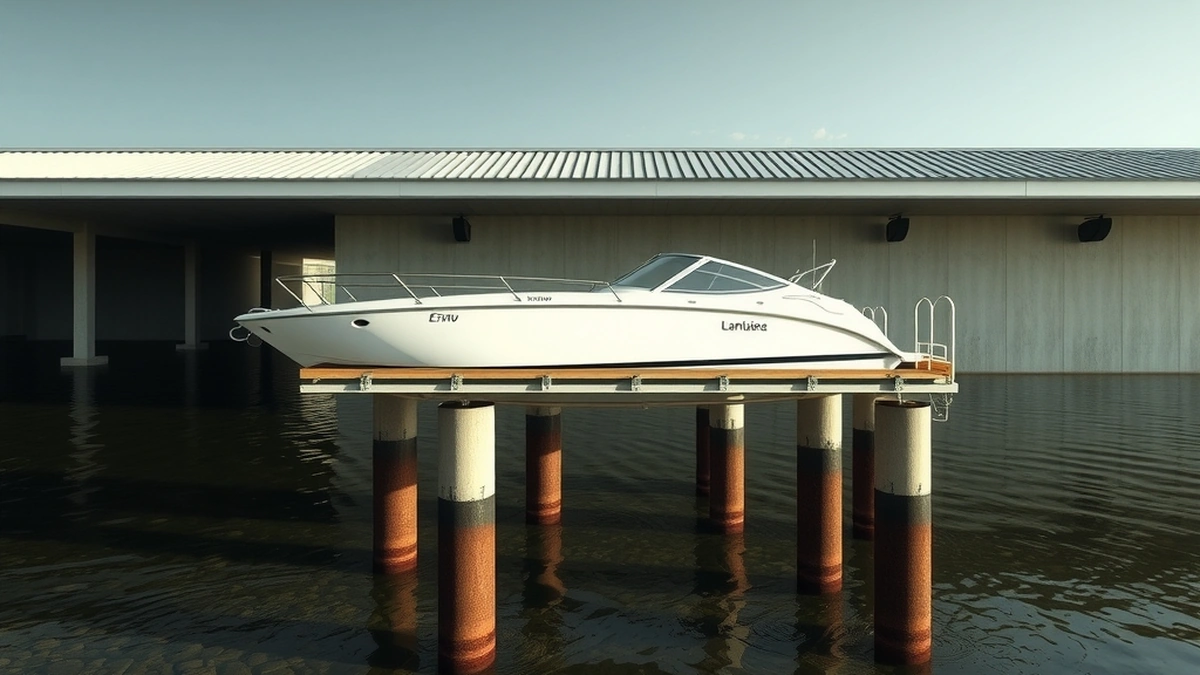
Prevent shallow water by measuring depth at low tide, dredging or relocating the lift, and maintaining proper clearance between the cradle and bottom.
- Safe minimum depth
- 18-24 inches below keel
- Dredging cost (estimate)
- $500-$3,000
- Lift relocation cost
- $1,000-$3,000
- Best time to check
- Lowest tide of the year
Some links on this page are affiliate links.If you buy through them we may earn a commission at no extra cost to you. We do not accept payment for rankings. Read the full disclosure.
Shallow water prevents a boat lift from doing its job. You prevent it by measuring depth at the lowest tide, removing sediment, or relocating the lift to deeper water. Ignoring it leads to hull contact, cradle strain, and expensive repairs.
Measure Depth Before You Buy or Install
Water depth changes with tide, season, and rainfall. A spot that looks deep in spring can expose mudflats by late summer. Measure at the lowest tide of the year, not at high tide. Use a weighted line or depth finder and record the measurement in feet and inches.
For most recreational boats, you want at least 18 to 24 inches of water below the keel at low tide. That clearance protects the hull and gives the lift cradle room to float or settle without dragging. If your measurement falls short, the site needs work before installation.
Understand How Lift Type Affects Depth Needs
Different lifts sit at different heights in the water. A cradle lift supports the hull from underneath and often rides lower, which means it needs more water depth than an elevator lift of the same capacity. A 4,000 lb cradle lift typically costs $5,000 to $12,000, while a 10,000 lb elevator lift runs $12,000 to $25,000. Hydraulic models can reach $15,000 to $35,000. PWC lifts are smaller, usually $1,500 to $5,000, but they still need enough water to float the craft onto the bunks.
Installation adds $1,000 to $3,000 on average. If you choose the wrong lift for your depth, you may pay to remove it and install a different model. Match the lift to your lowest measured depth, not your highest.
Dredge to Restore Depth
Dredging removes silt, sand, and organic matter from around the lift and dock. For a small residential area, expect estimates of $500 to $3,000 depending on cubic yards removed and local disposal rules. If you remove 10 cubic yards of sediment at $200 per yard, that is $2,000 before hauling and permits.
Check local regulations before you start. Many jurisdictions require permits for dredging, especially near wetlands or navigable waterways. The EPA provides guidance on water quality and discharge rules, and local building authorities often regulate dock and shoreline work. Never assume you can dig freely.
Relocate the Lift or Dock
Sometimes moving the lift is cheaper than dredging every year. Relocation typically costs $1,000 to $3,000 and includes disconnecting the unit, moving pilings or mounts, and reinstalling in deeper water. If your dock is fixed, you may need to extend it or add a floating section.
Dock construction runs $15,000 to $60,000 depending on size, materials, and piling depth. Before spending that much, compare the cost of a one-time move against recurring dredging. A deeper site also reduces wear on the lift motor and cables because the cradle does not bottom out.
Maintain Clearance With Regular Checks
Water depth is not static. Storms wash in new sediment, and vegetation can accumulate around pilings. Check depth quarterly and after major storms. If you lose even 6 inches of clearance, plan maintenance before the boat grounds.
A grounded boat can crack the hull, damage the propeller, and stress lift cables. Repair costs vary widely, but catching a depth issue early costs far less than a hull repair or cable replacement. For ongoing care, see our boat lift maintenance guide. If you already have damage, our boat lift repair page covers common fixes.
Match Capacity to Conditions
Shallow water increases the risk that the lift settles into the mud. A 4,000 lb cradle lift with a boat weighing 3,200 lb leaves 800 lb of capacity. If the cradle sinks 4 inches into soft silt, the effective clearance drops by that amount. Calculate your actual load: boat weight plus fuel, water, and gear. A 3,200 lb boat with 300 lb of fuel and 200 lb of gear weighs 3,700 lb, leaving only 300 lb of margin on a 4,000 lb lift.
For heavier boats, a 10,000 lb elevator lift at $12,000 to $25,000 provides more headroom, but it still needs adequate water depth to operate. Capacity does not replace depth. Both must be correct for the site.
Plan Around Tides and Seasons
In tidal areas, depth can swing by several feet between high and low tide. Measure at mean low water or lower low water, not average tide. If your lift sits in 24 inches at high tide but only 8 inches at low tide, the boat will rest on the bottom twice a day.
In freshwater lakes, seasonal drawdowns can expose dock pilings and lift frames. Note the lowest level from previous years and design for that mark. It is better to install in deeper water and use a shorter lift leg than to install shallow and dredge annually.
Budget for Prevention
Preventing shallow water costs less than repairing the damage it causes. Here is a sample cost comparison:
| Action | Estimated Cost |
|---|---|
| Depth survey and measurement | $0-$150 |
| Small dredging project | $500-$3,000 |
| Lift relocation | $1,000-$3,000 |
| Professional installation | $1,000-$3,000 |
| Dock extension or reconfiguration | $15,000-$60,000 |
These are estimates. Actual prices depend on your location, contractor rates, and site conditions. Get at least two quotes before committing to dredging or construction.
When to Call a Professional
If you are unsure about depth measurements, permit requirements, or lift placement, consult a dock or marine contractor. They can assess bottom composition, tidal range, and the best lift type for your site. Professional installation typically costs $1,000 to $3,000 and reduces the risk of setting the lift too shallow.
For help choosing the right lift, see our best boat lift guide. If you are weighing a lift against a fixed dock, our boat lift vs boat dock comparison breaks down the tradeoffs. DIY builders should review our DIY boat lift article before starting.
Shallow water is predictable if you measure at the right time and plan for the worst-case tide. Prevent it once, and you protect the boat, the lift, and your budget for years.
Next, compare how much does boat lift cost, boat lift installation, boat lift repair before you commit.
Frequently asked questions
What causes shallow water near a lift?
Sediment buildup, shifting sandbars, seasonal low tides, and runoff from nearby shore can all reduce water depth over time.
How deep should water be under a boat lift?
You generally need at least 18 to 24 inches of water below the boat's keel at the lowest expected tide to avoid grounding.
Can I dredge around my boat lift myself?
Small handheld dredging may work for minor silt, but larger projects usually require permits and professional equipment.
Does a cradle lift handle shallow water better?
A cradle lift sits lower in the water, so it often needs more depth than an elevator-style lift at the same boat weight.
How much does lift installation cost?
Professional installation typically runs $1,000 to $3,000, depending on lift type and site conditions.
Should I move my lift if water stays shallow?
Yes. Relocating to deeper water or reconfiguring the dock layout is often cheaper than repeated dredging or hull repairs.
Sources
Some links are affiliate links.If you buy through them we may earn a commission at no extra cost to you. We do not accept payment for rankings. Read the full disclosure.