Hydraulic vs Cradle Lift Guide
Choosing between a hydraulic and a cradle lift for your private dock can be difficult. We compare costs, capacities, and maintenance to help you decide.
A hydraulic lift costs $15,000 to $35,000 and handles up to 10,000 lbs, while a cradle lift costs $5,000 to $12,000 and supports up to 4,000 lbs. Choose hydraulics for heavy loads, craddles for budget.
- Typical range
- Varies by system and site
- First step
- Measure the space and confirm the load
- Professional help
- Recommended for structural or electrical work
Some links on this page are affiliate links.If you buy through them we may earn a commission at no extra cost to you. We do not accept payment for rankings. Read the full disclosure.
A hydraulic lift costs $15,000–$35,000 and a cradle lift costs $5,000–$12,000, and both need $1,000–$3,000 of installation, so the real gap is roughly $10,000 to $23,000. Hydraulic suits heavy boats, deep water and frequent use; a cradle lift suits lighter boats, shallow slips and tighter budgets. The decision usually comes down to loaded boat weight and low-water depth, not brand preference.
How the Two Lifts Work
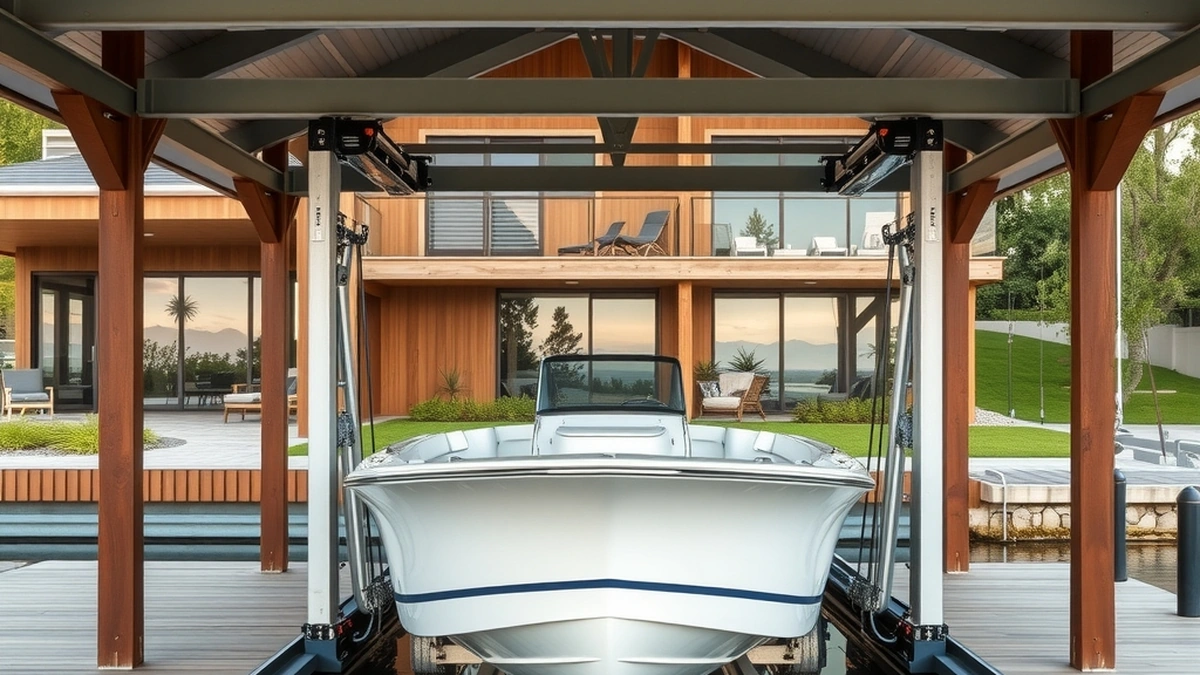
A cradle lift supports the hull on padded bunks or beams and raises that cradle with a cable, strap or screw drive. The boat sits in a shaped bed, which is efficient for a hull that fits it and unforgiving for one that does not.
A hydraulic lift raises the boat with fluid pressure driving cylinders, either under a platform or through lifting arms. Travel is smooth, the system holds position without a brake fighting the load, and the mechanism handles heavy vessels without a drum of cable. The cost of that capability is a pump, hoses, seals and fluid that all need attention.
Cost Compared
Equipment and installation are the first two lines. A hydraulic system is $15,000–$35,000, and a cradle lift is $5,000–$12,000. Installation for either is $1,000–$3,000.
| Line item | Hydraulic lift | Cradle lift |
|---|---|---|
| Equipment | $15,000–$35,000 | $5,000–$12,000 |
| Installation | $1,000–$3,000 | $1,000–$3,000 |
| Installed total | $16,000–$38,000 | $6,000–$15,000 |
| Typical capacity | Up to about 10,000 lb | About 4,000 lb |
| Drive | Pump, cylinders, hoses | Cable, strap or screw |
The installed totals are additions. At the low end, $15,000 + $1,000 = $16,000 for hydraulic and $5,000 + $1,000 = $6,000 for cradle. At the high end, $35,000 + $3,000 = $38,000 and $12,000 + $3,000 = $15,000. Comparing the two low ends gives a $10,000 gap; comparing the two high ends gives $23,000.
Capacity and Weight Math
Capacity is where the price difference earns its keep. Take a boat that weighs 6,800 lb loaded with fuel, water and gear. A 20 percent margin is 6,800 × 1.20 = 8,160 lb, which is beyond the 4,000 lb cradle class and inside the hydraulic range. The cradle lift is not overpriced in that comparison; it is the wrong tool.
Run the same math on a 3,100 lb boat. Add 20 percent: 3,100 × 1.20 = 3,720 lb. A 4,000 lb cradle lift covers that with 280 lb to spare, and paying hydraulic prices would buy capacity the boat cannot use. The rule is to size to the loaded weight, not to the hull’s published dry weight, and then leave margin.
Water Depth and Dock Fit
Cradle lifts generally work in shallower water because the cradle sits close under the hull and does not need a large open space beneath the boat. Hydraulic lifts, especially platform designs, need enough depth for the boat to float on and off and for the mechanism to travel.
That makes depth the second filter after weight. A slip holding 3 feet at low water may take a cradle lift where a hydraulic platform cannot enter. A slip holding 6 feet opens both options, and then the choice returns to boat weight and how often the lift is used.
Dock structure matters as well. Both types load the dock, but a hydraulic lift carrying a heavy boat concentrates more weight and often needs bracing or additional pilings. If the dock is old, price the structural work before comparing lift prices, or the cheaper lift may not be the cheaper project.
Maintenance and Running Costs
Neither lift is maintenance-free, but the work is different. A cradle lift asks for cable inspection, sheave lubrication and bunk replacement. A hydraulic lift asks for fluid checks, hose inspection, seal attention and pump service, plus the same structural checks.
Budget a few hundred dollars a year for either, as a planning estimate rather than a quote, and expect the hydraulic side to sit at the upper end as the system ages. Cables are consumables on a cradle lift, replaced on a schedule. Hoses and seals are consumables on a hydraulic lift, replaced when they weep or stiffen. Neither failure is cheap if it drops a boat.
Where Each One Wins
A cradle lift wins on purchase price, on shallow water, and on boats in the 2,000–4,000 lb range where its capacity fits comfortably. It also wins on simplicity: fewer systems, fewer things to leak.
A hydraulic lift wins on heavy boats, on hulls that do not sit well in a fixed cradle, on deep-water docks, and on owners who raise and lower the boat often. The smooth travel and position holding are genuine advantages when the boat is large.
There is a middle case worth naming. If the boat sits near 4,500–5,000 lb loaded, a larger cradle lift may exist but the margin gets thin, and an elevator or hydraulic design starts to make sense. In that band, compare a cradle lift cost quote against a hydraulic cost quote on the same scope before deciding.
Choosing in Five Steps
- Weigh the boat loaded, including fuel, water, gear and any tower or hardtop.
- Multiply by 1.20 and write down the rated capacity you actually need.
- Measure low-water depth at the dock and compare it with each design’s entry requirement.
- Have the dock or pilings assessed for the loaded weight, not the empty lift.
- Get installed quotes for both designs on identical scope, then compare maintenance obligations.
Only after those five steps does brand, finish or control type deserve a vote.
Whichever way it goes, the lift has to be rated for the load and installed by someone who will stand behind the structural and electrical work. For upkeep on the hydraulic side, see hydraulic maintenance; for the cradle side, cradle lift maintenance. If you are still mapping the category, types of boat lift and boat lift cost give the wider picture.
Frequently asked questions
What is the weight capacity of a typical cradle lift?
A standard cradle lift safely supports up to 4,000 pounds, making it ideal for smaller boats and personal watercraft.
How much does a hydraulic boat lift cost?
Hydraulic lifts generally range from $15,000 to $35,000 depending on size, material, and installation complexity.
Are hydraulic lifts more expensive than cradle lifts?
Yes, hydraulic lifts typically cost $15,000 to $35,000 compared to $5,000 to $12,000 for cradle lifts.
Can I install a hydraulic lift myself?
DIY installation is possible but risky, especially for hydraulic systems, which require professional plumbing and electrical work.
What is the installation cost for these lifts?
Installation typically costs $1,000 to $3,000 extra on top of the lift's base price, depending on local labor rates.
Do hydraulic lifts require more maintenance than cradle lifts?
Yes, hydraulic lifts need regular fluid checks and pump inspections, whereas cradle lifts rely on simpler mechanical linkages.
Sources
Some links are affiliate links.If you buy through them we may earn a commission at no extra cost to you. We do not accept payment for rankings. Read the full disclosure.